 Wonders of
 El Jem, the amphitheatre that has stood for 1,800 years
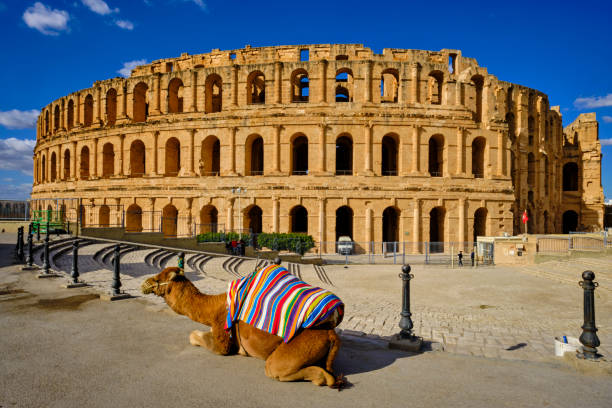
You reach El Jem along an ordinary road, past olive groves and low houses. Then the town opens up and there it is: a three-tier Roman amphitheatre sitting among people's homes, so large that it takes a moment to work out what you are looking at. It is the third biggest in the Roman world, and one of the best preserved anywhere.
The essentials
| Where | El Jem, Mahdia Governorate, central Tunisia |
| Ancient name | Thysdrus |
| Built | Around 238 AD |
| Capacity | About 35,000 spectators |
| Status | UNESCO World Heritage Site since 1979 |
| Time needed | 1 hr 30 to 2 hrs, museum included |
| From Sousse | About 1 hr by road |
Why a monument like this in the middle of nowhere
The answer comes down to one thing: oil. Thysdrus sat at the heart of an enormous olive-growing region, and African olive oil left by ship for Rome. The town grew rich, very rich, and like every prosperous Roman city it wanted an amphitheatre of its own. Not a modest one. The most impressive one it could build.
Work started around 238, under the proconsul Gordian. The building measures roughly 148 metres by 122, and once rose close to 36 metres across three levels of arcades. Unlike the Colosseum in Rome, built partly from brick and Roman concrete, El Jem is almost entirely cut stone, hauled in from quarries some thirty kilometres away. That is a large part of why it has held up so well.
It appears never to have been fully finished. The Empire slid into crisis, the money ran out, and parts of the upper levels were left incomplete.
What you actually see on site
You come in at arena level. The first thing that strikes you is how far you can wander. Plenty of ancient sites are hemmed in by ropes and keep-out signs. Here you climb the tiers, walk the corridors and go down beneath the arena.
The tiers
You can climb right up to the top levels. From there you take in the full ellipse of the arena along with the rooftops of the modern town around it and the olive groves behind. It is the best place to grasp the scale of the building, and the best viewpoint for photographs.
The passages under the arena
This is the part our guests talk about most on the way home. Two galleries cut in a cross beneath the arena, where gladiators and animals waited before being hoisted up by lift. You go down and walk through them. The acoustics, the cool air, the light dropping through the openings overhead: this is where what the place was built for becomes real.
The arena
The arena floor is long gone, so you look straight down into the underground structure from above. A walkway lets you cross it.
The mosaic museum, worth making time for
A few minutes from the amphitheatre is the El Jem archaeological museum, and plenty of visitors skip it because they are short of time. That is a mistake. Thysdrus produced one of the finest collections of Roman mosaics in Tunisia, second only to the Bardo in Tunis.
What changes everything is how close you can get: a few centimetres from the mosaics. You can pick out the individual tesserae, the shifts in colour, the places where the mosaicist corrected his work. Hunting scenes, animals, sea gods, and entire floors lifted from the villas nearby. Allow 30 to 45 minutes.
A history that does not stop with the Romans
After antiquity the amphitheatre served as a fortress. Local tradition says that al-Kahina, a figure of Berber resistance to the Arab conquest in the 7th century, held out inside it. Later, in 1695, troops opened a breach in the wall with cannon fire to drive out rebels who had taken shelter there. The wide gap you can still see on one side dates from that.
In the 20th century the film crews arrived. Scenes from Monty Python's Life of Brian were shot here in 1979, and the site is regularly listed among the settings that inspired sword-and-sandal epics.
Tips for your visit
- Come in the morning. The stone and the arena throw the heat straight back at you, and there is almost no shade. In summer, anything after 11 am is hard going.
- Closed, comfortable shoes. The tiers are uneven and the floor of the passages is rough.
- Bring water. There are very few places to buy anything inside.
- Winter and spring are the best seasons. You can visit without suffering in the heat, and there are fewer people about.
- Keep time for the museum. Two hours on site covers both without rushing.
Getting there
El Jem sits in the centre of the country, about an hour's drive from Sousse, slightly less from Mahdia, and roughly two hours from Hammamet. The town is also on the train line from Sousse and Sfax, but the timetables often leave little room for a relaxed visit.
We run an excursion that combines the amphitheatre, the passages under the arena and the mosaic museum, with pick-up at your hotel. Transport, guide and entrance fees are included, which saves you the ticket queues and the logistics of getting back.
Frequently asked questions
Yes. Both galleries under the arena are open to the public and they are one of the highlights of the visit. The floor is uneven, so closed shoes are better.
Allow about an hour for the amphitheatre on its own, and 1 hr 30 to 2 hrs if you add the archaeological museum, which we recommend.
No. The Colosseum is still the largest Roman amphitheatre. El Jem comes third by size, but it is far less busy and you can move around much more freely, the underground passages included.
Yes, and children usually love the passages under the arena and the climb up the tiers. Keep an eye on them on the stairs, which are old and in places have no handrail.
October to April. The temperatures make walking and climbing easy, and the site is quieter than at the height of summer.
Visit El Jem with us
Amphitheatre, underground passages and mosaic museum. Departures from Sousse, Monastir, Mahdia and Hammamet, transport and entrance fees included.
See the El Jem excursion → Map of places to visit