 Wonders of
 Matmata, the village dug into the earth where people have lived for centuries
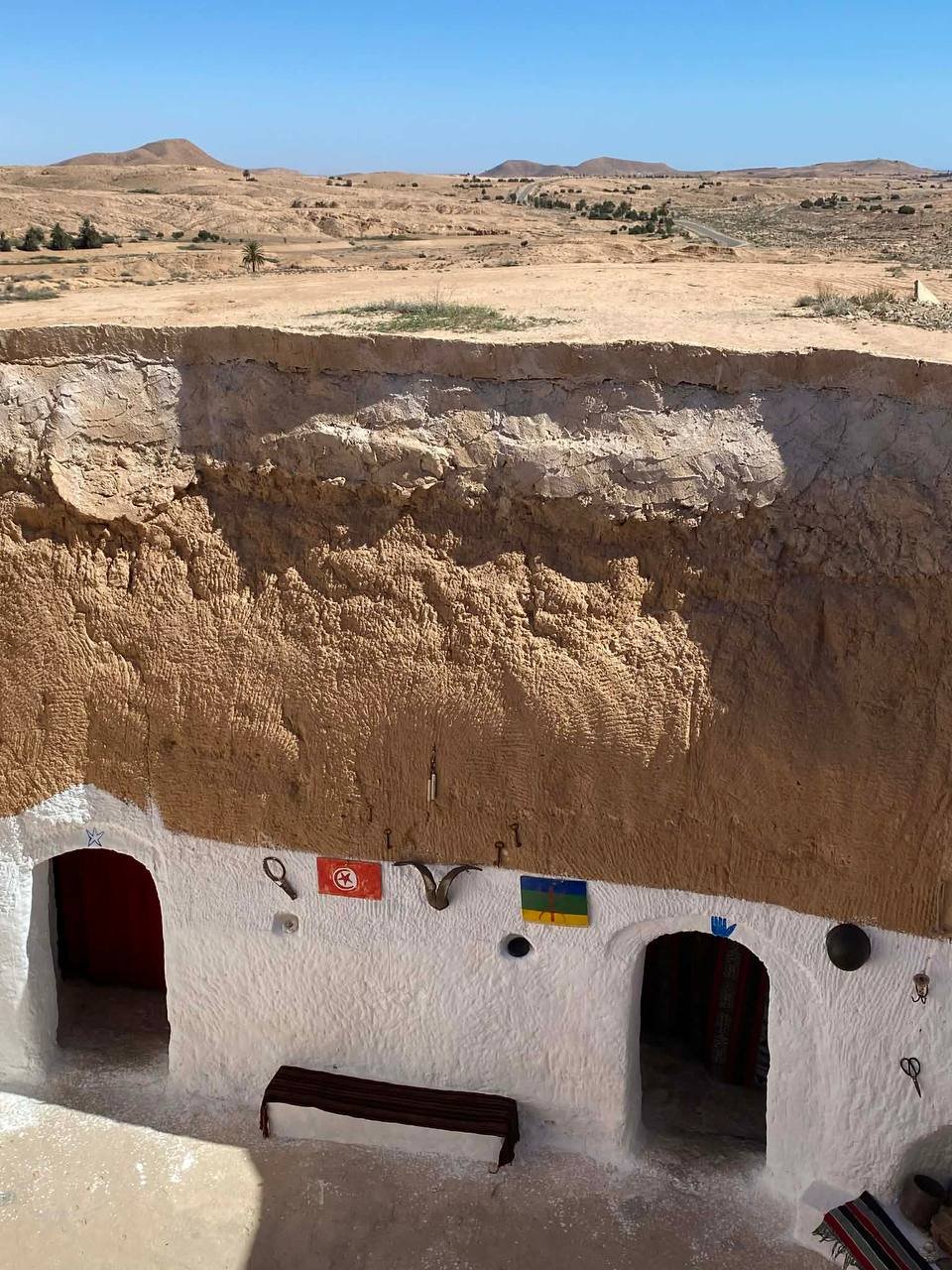
You reach Matmata on a road that climbs gently between rounded, almost bare hills, and then you start to notice craters. Circular holes in the ground, with openings cut into the inner walls. Those are the houses. Homes dug several metres below ground level around open-air courtyards, lived in for centuries by the Berber families of the region.
The essentials
| Where | Matmata, Gabes Governorate, southern Tunisia |
| Berber name | Tmaṭṭ |
| Altitude | About 600 metres |
| Population | About 2,000 people (old Matmata) |
| Time needed | 1 hr to 1 hr 30 |
| From Sousse | About 4 hrs 30 by road |
Why dig houses into the ground
The reason is the climate. Southern Tunisia is crushed by heat in summer, with temperatures regularly above 40 °C, and winter nights can drop close to zero. Digging underground keeps the temperature steady all year, somewhere around 20 to 22 °C, with no heating and no air conditioning.
The other reason is historical. These half-buried houses, barely visible from a distance, gave families protection against raids and invasions. A village cut into the ground is much harder to spot than one built on the surface.
The principle is simple: you dig a circular or oval courtyard roughly 8 to 10 metres across and 6 to 8 metres deep. Then you hollow out rooms all around it, into the vertical walls of the courtyard. Each room has its own purpose: bedroom, kitchen, grain store, stable for the animals. A sloping tunnel connects the courtyard to the surface.
What you see when you visit Matmata
The houses open to visitors
Several families in Matmata have set aside part of their home to receive visitors. You walk down the entrance tunnel and come out into the inner courtyard, ringed with doors painted blue or white. The rooms are small and cool, cut straight into the soft rock. Some have kept their traditional furnishings: Berber rugs, pottery, kitchen tools, oil jars.
Families often welcome you with mint tea, and sometimes bread baked on the spot in a traditional clay oven. It is a good moment to ask about daily life in these houses, how they were built, what winter is like, where the water comes from.
Hotel Sidi Driss and Star Wars
This is the best known cave house in Matmata, and probably in all of Tunisia. In 1976, George Lucas was looking for a location to film the interior of Luke Skywalker's home on Tatooine. He chose Hotel Sidi Driss. The circular courtyard, the white doors, the light falling in from the sky: it was all there.
The hotel is still running, and part of the film set has been kept. You can see the dining room where Luke has breakfast with his aunt and uncle, recognisable by its white walls, its alcoves and its rebuilt furniture. For fans of the saga, it is a compulsory stop.
The lunar landscape around the village
Matmata sits in a landscape of dry, rounded hills with almost no trees and earth that runs from ochre to grey. On a clear day you can see a very long way. It is this particular terrain, shaped by erosion, that inspired the desert settings of Star Wars. Walk a short way out of the village and you understand why this corner of the world stood in for a distant planet.
New Matmata and the move away
In 1969, after torrential rain flooded and destroyed several of the underground houses, the government built New Matmata a few kilometres away. A modern village on the surface, with solid-built houses, electricity and running water. A large part of the population moved there.
But not everyone left. Several hundred people still live in the dug-out houses of old Matmata. Some families have restored their homes, added electricity and water, and stay there all year round. This is not a museum village, it is a place where people live.
Berber life in Matmata
People in Matmata speak Berber (Tamazight) as their first language, in a dialect particular to the region. The traditional way of life was built on dry farming (barley, olives), herding goats and sheep, and making rugs and pottery.
Tourism has become an important source of income, but the older trades have not disappeared. You will still see women weaving Berber rugs by hand, clay bread ovens, and olive oil jars stored in the cool back rooms.
Tips for your visit
- Come in the morning or late afternoon. The light is softer for photographs, and it is cooler for walking around the village.
- Dress simply. Matmata is a village where people live, not a theme park. Modest clothing is appreciated.
- Bring water and a hat. The sun is strong and there is very little shade outside the houses.
- Carry small change for tips. If a family invites you into their home, a small gesture always goes down well. Our guide will tell you on the spot what is usual.
- Do not photograph people without asking. A gesture of the hand or a polite word is enough.
Getting there
Matmata lies about 40 kilometres south-west of Gabes, in southern Tunisia. From Sousse it is roughly 4 hrs 30 by road, and about 2 hrs 30 from Djerba. The village is often part of the southern tours that combine Matmata, the ksour (fortified Berber villages) and the desert.
We run a day trip from the coast with transport, a local guide and a visit to a traditional house. Depending on the option you choose, the route takes in other sites in the south as well.
Frequently asked questions
Yes. Matmata has several cave hotels, including the well known Sidi Driss. Sleeping in a house dug into the ground is a genuinely unusual experience, especially if you like quiet places that are a bit out of the ordinary.
Yes. Hotel Sidi Driss, which was used as the set for Luke Skywalker's home in the first film (1977), is open to visitors. Part of the original set has been kept. You can go in even if you are not staying the night.
Yes. Several hundred people still live in the underground houses of old Matmata. It is not an abandoned village but a working one, where permanent residents and tourism exist side by side.
Spring (March to May) and autumn (October to November) give you the best conditions. Temperatures are comfortable and the landscape is greener after the winter rain. Summer is very hot above ground, even though the inside of the houses stays cool.
Families who open their homes ask for a small contribution, sometimes with a glass of tea included. The amounts vary from one house to the next and change over time: our guide handles it directly, and on our excursions this visit is already included.
Visit Matmata with us
The underground houses, a visit with a local family, the Star Wars set and the landscapes of the south. Departures from Sousse and the coast, transport and guide included.
See the Sahara 1 day excursion → Map of places to visit