 Wonders of
 Makthar, the Roman city on the high plateau
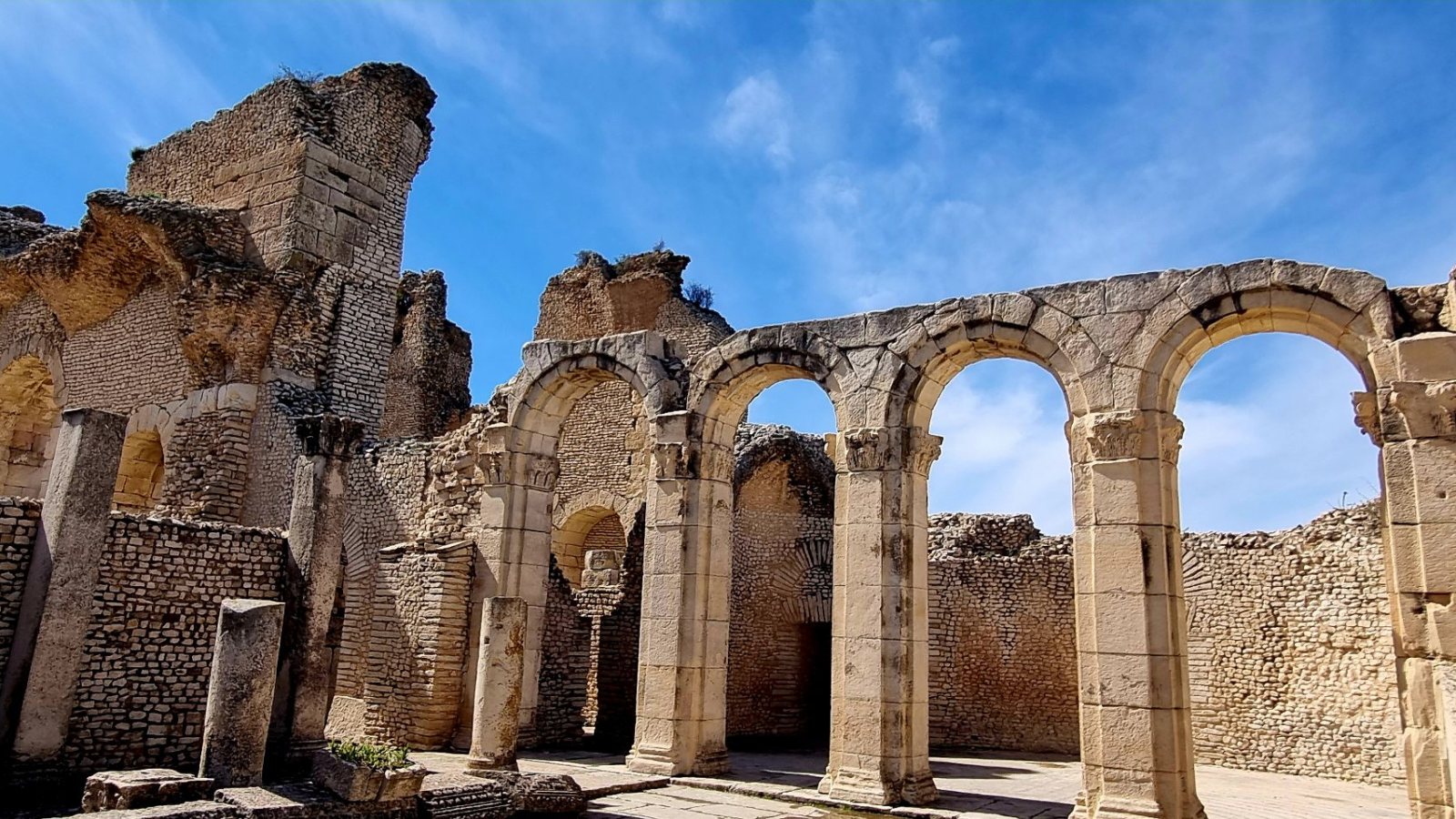
You climb towards Makthar on a road that winds between hills that keep getting higher, and the air changes. This is west-central Tunisia, around 900 metres above sea level, on a windy plateau where the olive groves give way to cereal fields. And there, in the middle of the crops and the sheep, an ancient city appears almost intact: the arch of Trajan, monumental baths, a forum, mausoleums. This is Mactaris, now Makthar, one of the best-preserved Roman towns in the country and one of the least visited.
The essentials
| Where | Makthar, Siliana governorate, west-central Tunisia |
| Ancient name | Mactaris |
| Origins | A Numidian town, then a Roman colony from the 1st century onwards |
| Altitude | Around 900 metres |
| Time needed | 1 h 30 to 2 h 30 |
| From Sousse | About 2 h 15 by road |
A Numidian town before it was Roman
Makthar was not founded by the Romans. The town already existed in the Numidian period, and the mausoleums you see as you arrive on site are the proof. These tiered funerary monuments are a reminder that this region was the heart of the Numidian kingdom before Rome arrived.
After the fall of Carthage in 146 BC, Rome gradually extended its control. Mactaris became a Roman town without losing its Numidian roots, and that is what makes the site interesting: you can follow the shift from one world to the other in the stonework itself.
The town grew wealthy on farming. The plateau is good land for cereals and olive oil. Most of the monumental building dates from the 2nd and 3rd centuries, the height of the town's prosperity.
The monuments not to miss
The arch of Trajan
This is usually the first thing you see on arrival. A monumental arch standing at the edge of the modern road, at the entrance to the ancient site. It is thought to date from the reign of Trajan, in the early 2nd century, and it marked the southern entrance to the town. Three of its faces are intact, with their piers and part of the attic storey. You walk right underneath it to enter the archaeological area.
The great southern baths
This is the best-preserved building on the site. You can walk through the hot, warm and cold rooms, see the heating system under the floor, the vaults still in place, the niches where the statues once stood. These baths were huge, public, and free or close to it, and their size says a lot about how important the town was in its day. Because so much survives, you come away with a concrete sense of how a complex like this actually worked.
The forum
The political and religious centre of the ancient town. You can still read the overall layout, the column bases, the shops around the square and the remains of the capitol, the temple dedicated to Jupiter, Juno and Minerva. On a clear day the view runs all the way to the surrounding mountains. The silence is almost total.
The basilica of Hildeguns and the schola of the Juvenes
A Roman civil basilica, used for trade and justice, with its columns and side walls still partly standing. Next to it is the schola of the Juvenes, a kind of club or association for young citizens, which shows that Mactaris had a properly organised social life. Latin inscriptions are still visible on the walls.
The Numidian mausoleums
Two large tiered funerary monuments, built before the Roman period, probably between the 3rd and the 2nd century BC. They resemble the mausoleums found elsewhere in North Africa, in particular the famous royal mausoleum of Mauretania in Algeria. They are there to remind you that this land was Berber long before it was Roman.
The small museum at Makthar
There is a modest but well-put-together museum at the entrance to the site. It holds stelae with Punic and Latin inscriptions, statues, mosaics and everyday objects. Some of the inscriptions are bilingual: Latin on one side, Libyc on the other. Another reminder of the double identity that defined this region.
A quiet, unspoilt site
Makthar is not on the usual tourist circuits. Coaches almost never come, visitors are few, and there are no souvenir sellers. You wander through the ruins as you please. In summer, when the coast is stifling, the altitude keeps Makthar bearable. Spring is beautiful here, with wild flowers taking over the ruins.
Practical advice
- Best time to go: spring or autumn, for the temperatures and the greenery.
- What to wear: hat, sun cream and good shoes. The site is large and stony.
- What to bring: water and a snack. There is no café or shop on site.
- How long: allow at least two hours to enjoy the quiet.
- Combine it with Dougga: the two sites are an hour apart.
Getting there
Makthar is a long way from the coast. From Sousse, allow about 2 h 15 going via Kairouan. From Tunis, a little over two hours. There is no direct tourist transport.
We include Makthar in our Grand Heritage Tour, often paired with Dougga or Sbeitla. Transport, guide and entrance fees are covered.
Common questions
Because it sits well away from the coast and the standard circuits. But that is precisely what makes it such a good site: you are almost alone there, and that changes the whole experience.
Yes, the site is easy to get around and there is nothing dangerous. Children generally love clambering over the ruins and exploring the baths. Bring water and something to nibble on, as the visit can run long.
There are a few small restaurants in the modern village near the site. Nothing touristy, more the kind of local canteens where you eat well and pay very little.
Dougga is bigger, better preserved and more spectacular. Makthar is more modest, more down to earth and far quieter. Both are worth seeing, for different reasons.
Not strictly, but a guide adds a great deal. Information panels are rare and the history of the site is complicated. With someone who knows it, you understand ten times more of what you are looking at.
Visit Makthar with us
The arch of Trajan, the Roman baths, the forum and the Numidian mausoleums. Included in our Grand Heritage Tour, departing from Sousse or Hammamet.
See the Grand Heritage Tour → Map of places to visit