 Wonders of
 Ksar Ouled Soltane, the fortified granary of the desert
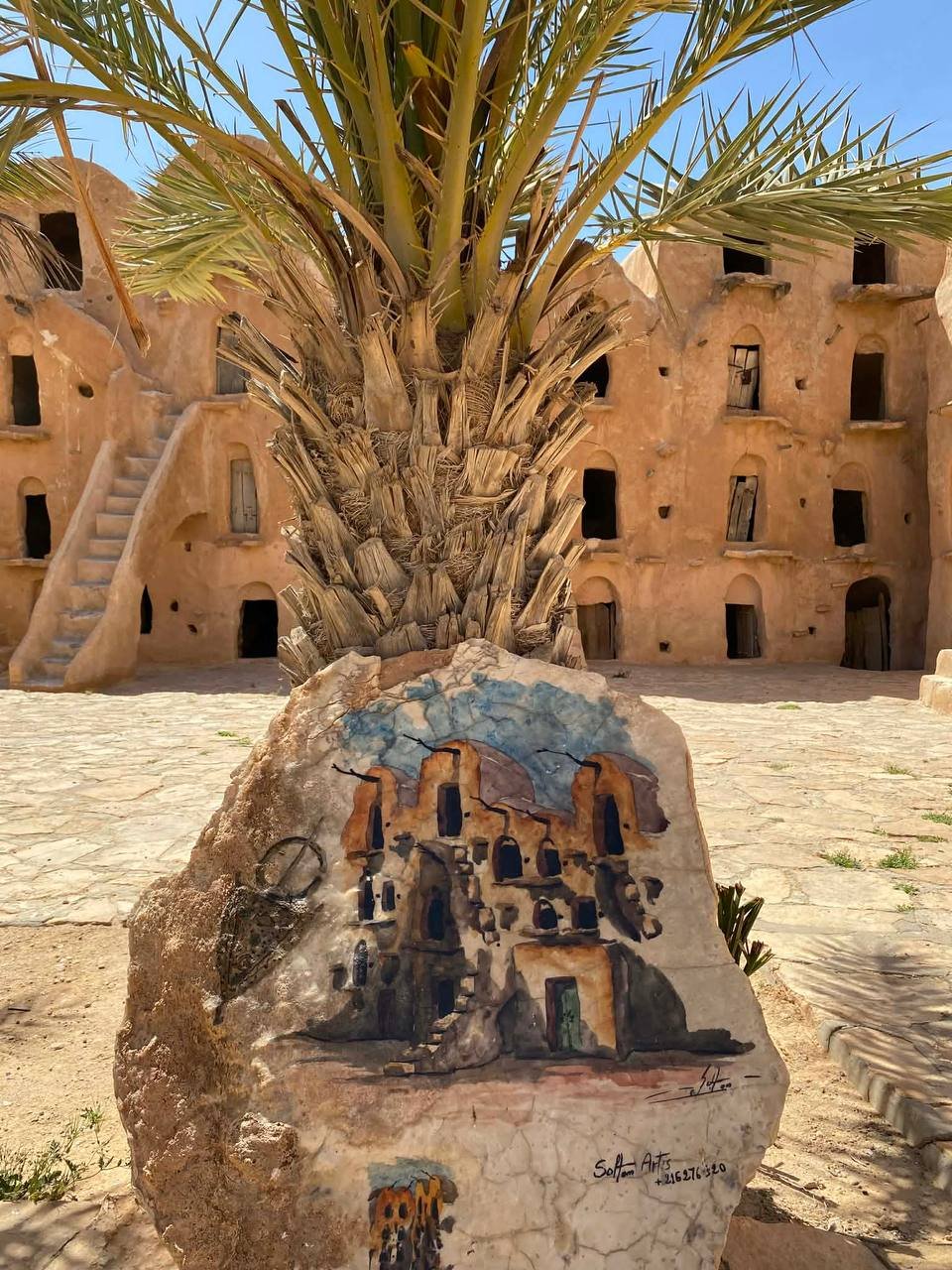
A few kilometres from Tataouine, set between two hills, stands one of the most striking fortified granaries in southern Tunisia. The storage cells, known as ghorfas, are stacked three and four levels high around two inner courtyards, linked by stairs of stone and packed earth. You walk in and you are in another century, the one in which Berber tribes kept their stores inside communal strongholds.
The essentials
| Where | Near Tataouine, Tataouine Governorate, southern Tunisia |
| Type | Ksar, communal fortified granary |
| Built | 15th century, extended in the 17th and 18th centuries |
| Time needed | 45 min to 1 hr 30 |
| From Sousse | About 5 hrs by road (on the Sahara 2 days excursion) |
What a ksar is and why it was built
The word ksar means a fortified village. In southern Tunisia it refers more specifically to these communal granaries, where semi-nomadic Berber tribes stored their harvests and their valuables while they moved with their herds. Each family owned one or more ghorfas, the vaulted cells stacked one on top of another.
Inside went barley, wheat, dates, olive oil in jars, rugs, jewellery and sometimes weapons. The ksar kept it all safe from theft, and the thick walls of stone and earth mortar kept the stores cool and dry.
There were dozens of ksour across the Tataouine, Medenine and Matmata regions. Ksar Ouled Soltane is one of the best preserved, and one of the few still standing in its entirety.
The architecture of the ghorfas
The first thing that hits you when you step into the courtyard is the height. The ghorfas rise three or four levels, and some reach around ten metres. Each cell runs about 3 to 4 metres deep, with a barrel vault that carries the weight of the ones above. The doors are low and narrow, once closed with palm-wood panels.
To reach the upper levels you take outside stairways cut into the stone or built up in packed earth. Some are steep, others form gentle ramps. There is no symmetry and no geometric plan. The ksar was extended whenever more space was needed, which gives it that organic, almost sculpted quality.
The two inner courtyards
The ksar has two separate courtyards, joined by a vaulted opening. The first and older one dates from the 15th century. The second was added around the 17th century, as the community grew. Each has its own set of ghorfas, laid out in a horseshoe or a rectangle.
That arrangement served both structural and security needs. The courtyards were shut at night, and families were allocated cells according to their standing and how long they had belonged to the tribe.
How a ksar was built
The materials came from the immediate surroundings. Local stone, quarried from the nearby hills, went into the load-bearing walls. The mortar, a mix of clay soil, chopped straw and water, bound the stones together and kept water out. The vaults were built in stone, over palm-wood centring that was removed once the work had set.
The walls are often 60 to 80 centimetres thick at the base. That thermal mass holds the cool in summer and keeps the cold out in winter. Inside the ghorfas the temperature stays steady at around 15 to 20 degrees whatever the season.
Building work was done collectively, on the principle of touiza, the tradition of mutual help. Each family worked on the others' cells and got the same support in return.
The ksar and Star Wars
Ksar Ouled Soltane was one of the real-world locations used for Star Wars: Episode I, The Phantom Menace, released in 1999. George Lucas filmed scenes here that were set on the planet Tatooine, a name taken straight from Tataouine.
The stacked ghorfas stood in for the slave quarters in the film, and their strange, almost otherworldly look fitted the universe of the saga without much help. Since then the ksar has drawn visitors from all over the world, Star Wars fans and curious travellers alike.
The production left little visible trace, but a few people in the area still keep photographs from the shoot, and some local guides will tell you stories about the film crews who took over the village for several days.
What a visit is like
You walk freely into the courtyards. No barriers, no ropes. You can climb the stairs, go inside some of the ghorfas, put your hand on the walls. That is one of the strengths of the place: nothing is staged, and you see it from the inside.
A few families still live nearby, and some of the ghorfas are still used for storage. Now and then a local resident will offer to show you a cell fitted out as a small museum, with traditional objects, old tools or Berber costumes. You pay what you think it is worth.
There is no set route. Start in the first courtyard, climb to the upper levels, come back down, move through to the second courtyard, work your way round. Allow somewhere between 45 minutes and an hour and a half depending on your pace and how much you like taking photographs.
No crowds
Unlike the better known sites in the north of the country, Ksar Ouled Soltane has largely been left alone by mass tourism. Apart from a few groups passing through in the morning or early afternoon, you will often have the place more or less to yourself, particularly in winter and spring.
Tips for your visit
- Wear closed shoes. The stairs are uneven and slippery in places, especially after rain.
- Take water. There is nowhere to buy anything inside, and the heat can be fierce in summer.
- Visit early in the morning or late in the afternoon. The light is better and the heat less punishing.
- Bring a hat in summer. The courtyards are open to the sky and there is very little shade.
- Treat the place with respect. Some ghorfas are still in use, so leave closed doors alone.
Getting there
Ksar Ouled Soltane lies about 20 kilometres south-east of Tataouine, on the road to Remada. You can drive yourself, but the trip from Sousse or the resort areas further north takes more than 5 hours. The south of Tunisia deserves more than a day.
We include Ksar Ouled Soltane in our Sahara 2 days excursion, which pairs this fortified granary with other ksour in the region, the cave villages of Matmata, the desert at Douz and the mountain oases. The tour lets you see the south without the navigation and the logistics.
Frequently asked questions
A few of them are, mainly as storerooms or as small private museums run by local families. Most are empty, but the structure itself is intact.
Yes, some of the ghorfas are open and accessible. Others are locked or still in use. You can move freely around the courtyards and climb the stairs.
No, as long as you watch your footing on the stairs, which are uneven and sometimes steep. With closed shoes and a little care there is no risk.
Access to the courtyards is free. If a local resident offers to show you a ghorfa set up as a museum, you give what you like, usually a few dinars.
Spring and autumn give you the best conditions. Summer is very hot. In winter the days are short but pleasant.
See Ksar Ouled Soltane with us
Ksar, cave villages, desert and oases over 2 days. Departures from Sousse, Monastir or Hammamet. Accommodation, transport and guide included.
See the Sahara 2 days excursion → Map of places to visit