 Wonders of
 Ksar Ghilane, the oasis where the desert really starts
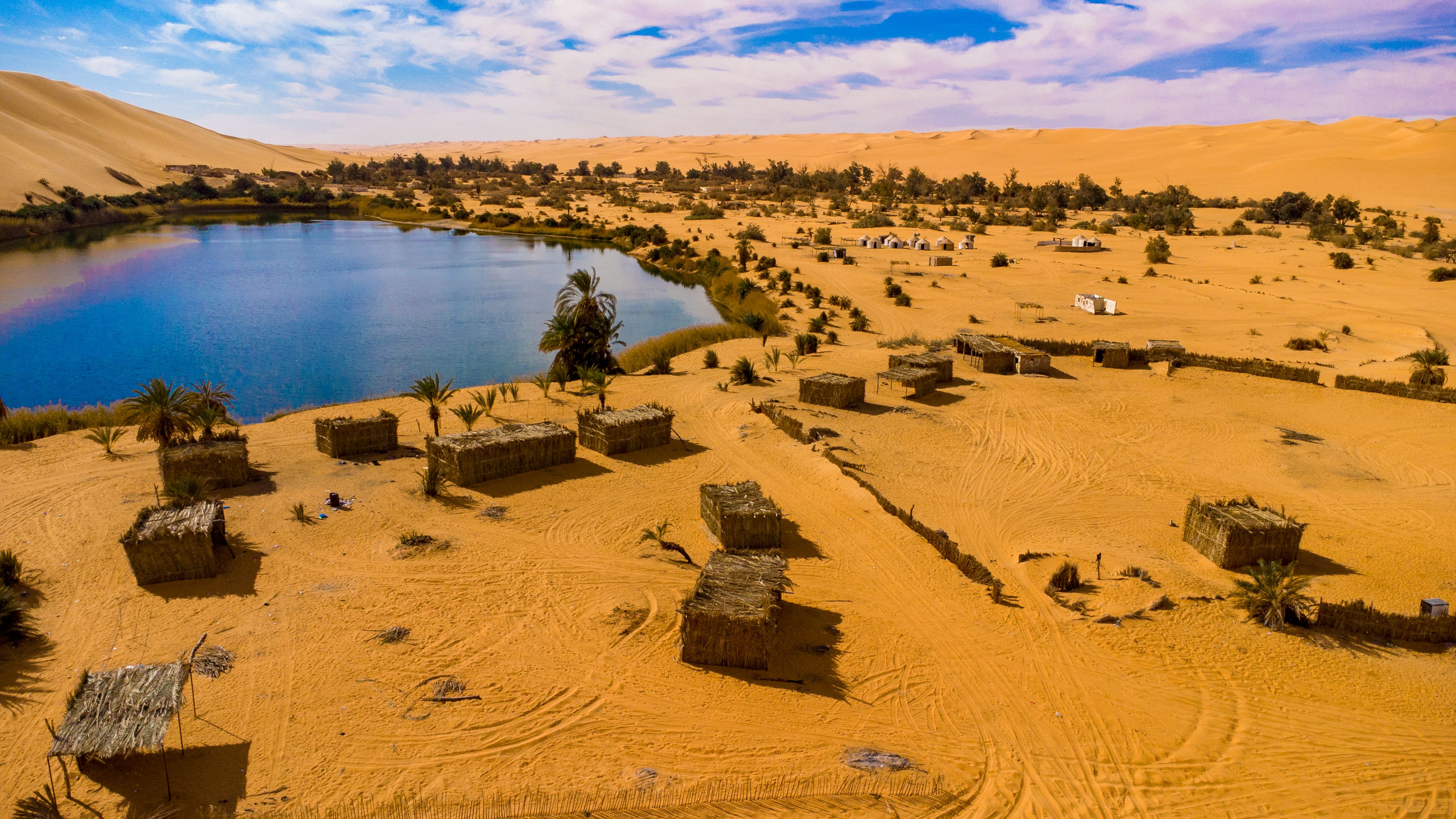
After hours on a rough track through stone and gravel, a green line appears in the distance. Palm trees, water, white tents. This is Ksar Ghilane, the last oasis before the Grand Erg Oriental, the vast sea of sand that runs on towards Libya. A waterhole in the middle of nowhere, with a hot spring coming out of the ground and dunes rising on the horizon.
The essentials
| Where | Southern Tunisia, Kebili Governorate |
| Distance | About 100 km south of Douz, on the edge of the Sahara |
| Altitude | About 120 metres |
| Road conditions | Unsurfaced track after Douz (4x4 recommended) |
| Time needed | Half a day at least, ideally one night |
| From Sousse | About 6 hrs by road |
An oasis at the end of the road
Ksar Ghilane sits in the far south of Tunisia, on the edge of the Grand Erg Oriental, one of the largest dune fields in the Sahara. For a long time it was a staging post for caravans crossing the desert between Tunisia and Libya, a vital waterhole before or after several days' march through the sand.
People come here now to see the desert the way they picture it: high golden dunes that shift shape with the wind, a palm grove that cuts against the dryness all around, and a sky so clear that at night you can see the Milky Way with the naked eye.
The oasis itself is small. A handful of Berber camps, one brick-built hotel, traditional tents for visitors, and a hot spring that comes up naturally out of the ground into a small pool you can bathe in all year round.
The hot spring
This is one of the real draws of Ksar Ghilane. A natural hot spring at around 30 to 35 °C feeds an open-air pool surrounded by palm trees. The water is clear and lightly mineral, and a soak in it after a day on the track is something our guests remember for a long time.
The pool is basic, put together with stone and concrete, but that is part of the appeal. You are deep in the desert, miles from the nearest town, bathing in warm water that comes straight out of the earth. There is nothing else quite like it.
When to go
The spring is open all year, but spring and autumn are the best times. In summer, hot water on top of the outside heat can be too much. In winter it works the other way round: bathing in warm water while the air is cold, sometimes down to 10 °C at night, is very pleasant indeed.
The dunes and the desert
A few kilometres from the oasis the real Sahara dunes begin. They can reach several tens of metres in height, with fine crests, gentle slopes on the windward side and sharp drops on the other. The sand is fine, almost red at sunset and golden in the middle of the day.
Our tours include a run out to the dunes by 4x4 or quad bike, with the option of walking up to the top. Climbing through sand is hard work, but the view from up there is worth it: waves of sand as far as you can see, complete silence, and usually nobody around but your own group.
Camel rides are also on offer, mostly in the late afternoon for the sunset. It is the obvious thing to do, but it is also the best time of day to be out in the dunes. The light is soft, the shadows stretch out and the temperature becomes bearable.
The Roman fort of Tisavar
About ten kilometres from the oasis are the ruins of a Roman fort called Tisavar. It was a military post on the limes, the fortified frontier of the Roman Empire that marked the line between Roman territory and the open desert.
Not much is left: sections of stone wall, the foundations of a watchtower, a few traces of buildings. But the place says something. Picture Roman legionaries stationed out here, watching the desert in crushing heat, hundreds of kilometres from Rome, and you get a sense of how big that empire was.
Not every tour includes the fort, but if you have the time and a guide who knows the area well, ask to go. It is a short detour that adds a layer of history to the day.
Sleeping under the stars
Several camps at Ksar Ghilane offer nights under canvas. These are not ordinary camping tents but large Berber wool tents furnished with rugs, cushions and low beds. The comfort is simple, but it is clean and the real thing.
In the evening you eat around a fire, often with traditional music playing. Then night falls and the show starts. The sky fills with stars, the Milky Way is plainly visible, and on a clear night you can count dozens of shooting stars in a few hours.
In the morning you wake with the sun coming up over the dunes. The light is pink, the air is cold and the silence is total. It is the kind of wake-up you do not forget.
What there is to do
Beyond the hot spring and a trip out to the dunes, there is plenty else to do at Ksar Ghilane:
- Quad biking in the desert. One- or two-hour circuits take you out into the dunes and across the stony plains. It is physical, good fun, and covers a lot of ground.
- Camel ride. Slower and more contemplative. Best at sunset.
- Walking in the dunes. If you like walking and can handle the heat, climbing to the top of a high dune and running back down is exhilarating.
- Stargazing. If you are staying the night, make the most of it. Some camps have telescopes.
Tips for your visit
- Come on an organised tour with a 4x4. The route from Douz is a difficult track, and getting lost in the desert is a real risk. A local guide and the right vehicle are essential.
- Bring a swimsuit. The hot spring is not to be missed, and bathing in your clothes would be a shame.
- Protect yourself from the sun. Hat, sunglasses, high-factor sun cream. The desert does not forgive.
- Dress in layers. The day can be very hot, but the nights are cold, especially in winter.
- Carry plenty of water. The air is dry and you dehydrate faster than you realise.
- Respect the quiet and the environment. Ksar Ghilane is a fragile place. Take your rubbish with you, leave the plants alone, and keep the peace.
Getting there
Ksar Ghilane can only be reached by 4x4, on a track that starts at Douz. The drive takes about 2 hours from Douz and crosses an expanse of reg (stone desert) before the oasis appears. From Sousse it is roughly 6 hours, a good part of it off the tarmac.
We run one-day and two-day excursions from the coast, the latter with a night on site. Transport by 4x4, guide, meals and accommodation under canvas are included. It is the safest and most comfortable way to see Ksar Ghilane without the logistical headache.
Frequently asked questions
Yes, the spring is open all year and the water stays at a steady 30 to 35 °C. In winter it is even better, because the cold air makes the contrast with the warm water all the more enjoyable.
Yes, there is no way around it. The track from Douz is sandy and stony, and impassable in an ordinary car. A 4x4 with an experienced driver is strongly recommended.
Yes, several camps offer nights in Berber tents. We strongly recommend it, both for the night sky and for the sunrise over the dunes. There is also a small brick-built hotel.
Spring (March to May) and autumn (October to November) have the most comfortable temperatures. Summer is very hot, above 40 °C, and winter nights can be cold, though it remains a good option if you do not mind the swing in temperature.
Coverage is very weak or non-existent depending on the network. Treat it as a chance to properly disconnect. Let people at home know before you leave, and enjoy the silence.
Visit Ksar Ghilane with us
Oasis, hot spring, Sahara dunes and a night under the stars. One- and two-day tours from the coast, 4x4 transport, guide and meals included.
See the Sahara 1 day excursion → Map of places to visit