 Wonders of
 Dougga, the forgotten Roman city in the hills
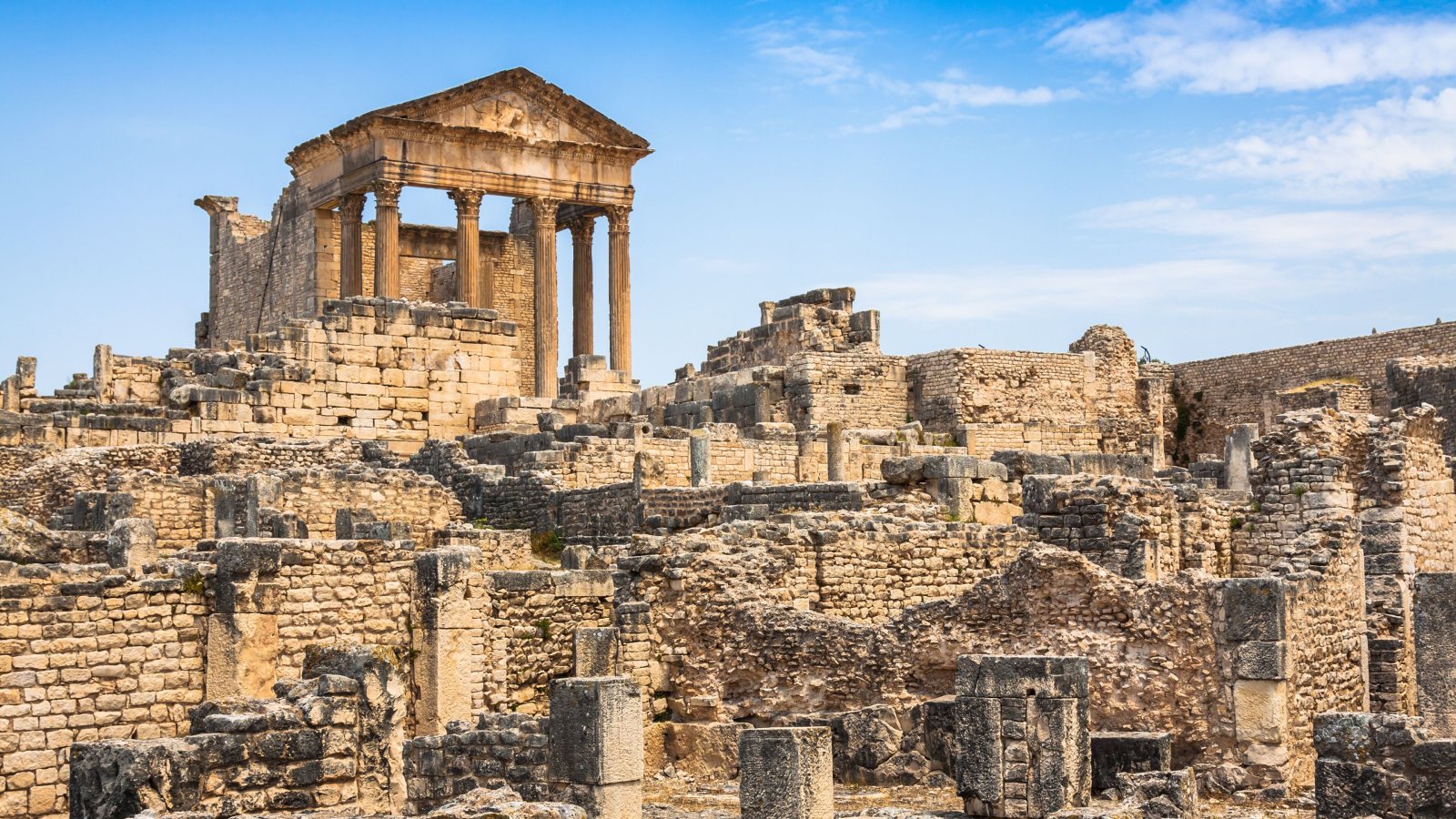
Some archaeological sites are a scrum of tour groups. Dougga is not one of them. An entire Roman town sits on a hillside in north-west Tunisia, ringed by olive groves and fields. The Capitol raises its six columns against open sky, the theatre still hosts performances in summer, and the paved streets wind between the baths, the temples and the houses of the local gentry. This is the best-preserved Roman town in North Africa, on the UNESCO World Heritage list since 1997, and still one of the quietest.
The essentials
| Where | Béja governorate, north-west Tunisia |
| Ancient name | Thugga |
| Origins | A Numidian town, Romanised from the 1st century onwards |
| Status | UNESCO World Heritage since 1997 |
| Time needed | 2 to 3 hours |
| From Sousse | About 2 h 30 by road |
Why Dougga is so well preserved
Most Roman towns were looted, built over, or taken apart stone by stone to serve as a quarry. Dougga escaped that fate for a simple reason: it was too remote. Once the Roman Empire collapsed, the town was gradually abandoned. People moved away, and nobody came to build on top of it.
In the 19th century a Berber village still occupied part of the site. Houses leaned against the Roman ruins, the ancient streets served as lanes, and the temples were used as stables. In the 1950s the Tunisian state moved the modern village a few hundred metres away and cleared the archaeological site.
The result is one of the most complete Roman ensembles anywhere: public monuments, residential quarters, squares, fountains, and even the communal latrines.
The Capitol, the symbol of the town
The Capitol is the most photographed building on the site. Six Corinthian columns eight metres tall, topped by a triangular pediment where you can still make out the carved reliefs showing the emperor Antoninus Pius being carried off by an eagle. The temple was built between 166 and 167 AD, under Marcus Aurelius, and dedicated to the Capitoline triad: Jupiter, Juno and Minerva.
You climb the steps, stand under the columns, and realise that almost nothing is missing. The podium, the walls of the cella, part of the entablature: it is all still in place. In front of the temple lies the old forum square, edged by porticoes whose column bases are still visible.
A temple paid for with local money
Funding a temple on this scale cost a fortune. At Thugga the bill was settled by a local family, the Marcii. The wealth came from farming, wheat and olives above all. The region was one of Rome's granaries, and the local notables spent their money Romanising the town, putting up monumental buildings and securing the status of Roman municipium.
The ancient theatre, still in use
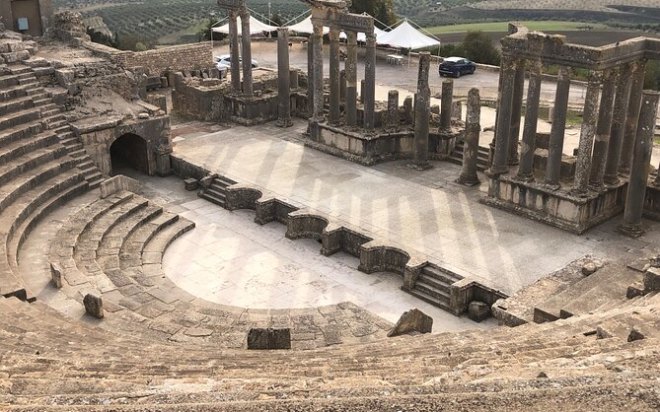
Dougga's theatre was built in the 2nd century, set against the slope of the hill to make use of the natural gradient. It held around 3,500 spectators on 19 rows of seating divided into three sections. The stage, the orchestra and part of the stage wall are still standing.
What makes this theatre exceptional is that it still works. Every summer the Dougga International Festival stages concerts and plays here. Sitting in the tiers under the stars, with the columns of the Capitol lit up in the distance, gives you a fair idea of what a performance felt like in antiquity.
The original acoustics
If you visit the theatre on a quiet day, test the acoustics. Stand in the middle of the orchestra and speak at a normal volume. You can be heard perfectly from the top row. Roman architects understood exactly how sound travels, and the theatre at Dougga proves it.
The other monuments worth your time
The temple of Saturn
Set on high ground above the site, the temple of Saturn stands where a Punic sanctuary to Baal Hammon once stood. The Romans kept the cult going and gave it a Roman name. The temple you see today dates from the 3rd century. From up there you get a panoramic view over the whole ancient town and the countryside around it.
The Licinian Baths
These public baths, built in the 3rd century, are among the best preserved in Tunisia. You can still pick out the different rooms: the changing room, the cold baths of the frigidarium, the warm tepidarium and the hot caldarium. The underfloor heating system and the water channels are still there to see.
The market and the latrines
Dougga's market, just off the forum, still has its columns and part of its shops. Right next to it are the public latrines, a semicircular room with a dozen pierced stone seats set side by side. For the Romans, going to the toilet was a social occasion, a place to talk business and politics.
The Libyco-Punic mausoleum
This 21 metre monument at the entrance to the site is one of a kind. Built in the 2nd century BC, before Romanisation, it combines Punic, Egyptian and Hellenistic influences. It is one of the few surviving examples of pre-Roman Numidian architecture. A bilingual inscription in Libyc and Punic was found here, which allowed scholars to partly decipher the Libyc alphabet.
A street plan that follows the land
Most Roman towns follow a rigid grid inherited from military camps. Dougga is the exception. The town was Numidian first and was Romanised gradually. Rather than flatten it and start again, the Romans fitted their planning to the slope and to what was already standing.
So the streets climb, drop, fork, widen and narrow. The forum is not at the geometric centre but on a terrace higher up. The houses cling to the hillside. That organic quality gives Dougga a different feel from other Roman sites: more lived-in, less military.
Why so few visitors
Dougga earns its place on the UNESCO World Heritage list as much as Pompeii or Ephesus. Yet most international travellers have never heard of it. There are a few reasons for that. Location first: Dougga is inland, a long way from the coastal resorts where Tunisian tourism is concentrated. Then there is the lack of promotion, since the site barely features in the standard tour circuits. And finally the distance from the big cities: around two and a half hours from Sousse or Tunis.
For us, that is exactly what makes Dougga worth the drive. You walk at your own pace, you take time over the details, you sit in the theatre without a group waiting behind you. It is a completely different kind of visit from the sites that are packed solid.
Visiting tips
- Allow at least two hours. The site is large, and it would be a shame to see only the Capitol and the theatre.
- Come early in the morning or late in the afternoon. The light is at its best and you avoid the midday heat.
- Wear closed walking shoes. The ground is uneven, with loose stones, stony paths and slopes.
- Bring water and something to eat. There is nowhere to buy anything inside the site.
- Winter and spring are the best seasons. In summer the heat can be punishing and there is little shade.
- A guide makes a real difference. Information panels are rare and usually only in Arabic and French.
Getting there
Dougga lies about 110 kilometres south-west of Tunis and 160 kilometres north-west of Sousse. Driving is the easiest way to get there, although the road crosses rural areas with very little signposting. Public transport will take you as far as the neighbouring town of Téboursouk, but from there it is a walk of about two kilometres or a ride in a local taxi.
We run an excursion that combines Dougga with other sites in the north-west, including Bulla Regia and its underground houses, as part of the Grand Heritage Tour. Transport, guide and entrance fees are included, which takes the logistics off your hands.
Common questions
Yes. You can climb into the theatre seating, walk along the streets, step inside the baths and explore most of the site freely. A few fragile buildings are fenced off.
Allow two hours at the very least for the main monuments. If you are keen on archaeology or photography, plan on three hours or more.
No. The finds from the excavations, the mosaics in particular, are on display at the Bardo Museum in Tunis. Dougga itself is an open-air site with no exhibition building.
Far less so than coastal sites like El Jem or Carthage. On a weekday out of season you can have the place almost to yourself. At weekends and during the Tunisian school holidays there are a few more people, but it stays very manageable.
Carthage was Punic and then Roman, and it sits close to Tunis, but the site is fragmented and hemmed in by modern buildings. Dougga is a complete Roman town out in the countryside, far better preserved and much easier for a visitor to make sense of.
See Dougga with us
Dougga, Bulla Regia, the Temple of the Waters at Zaghouan and other treasures of Tunisian heritage. Tour with an English-speaking guide, transport and entrance fees included.
See the Grand Heritage Tour → Map of places to visit