 Wonders of
 Tozeur, capital of the oases
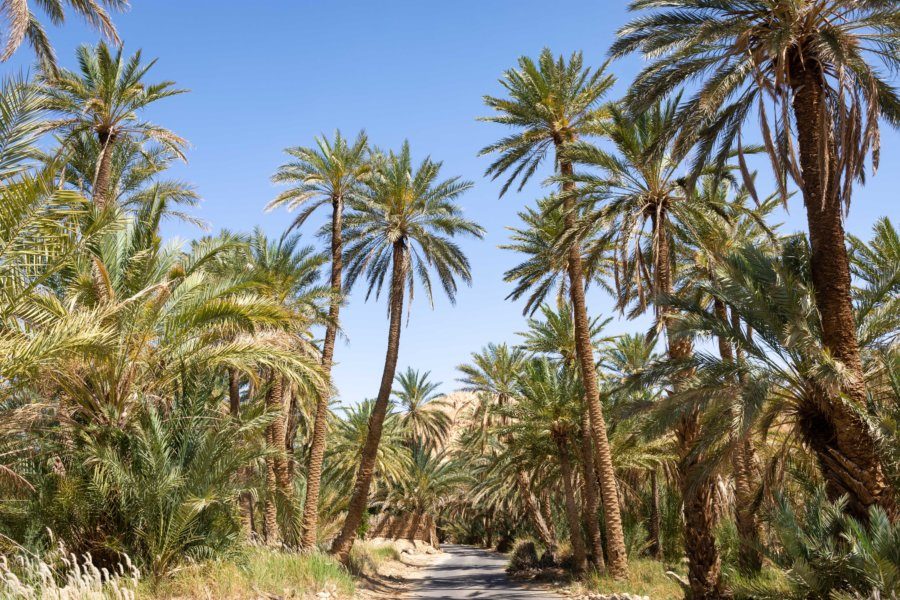
In southwest Tunisia, where the land flattens and the sky becomes enormous, Tozeur rises like a mirage that keeps its promises. A palm grove of more than 400,000 date trees, a medina built from yellow bricks arranged in geometric patterns found nowhere else in Tunisia, and on the horizon, the Chott el Jerid — the largest salt lake in the Sahara. Tozeur is the quintessential oasis town, a reminder that the desert is not just sand, but also water, cultivated soil and centuries of human ingenuity.
Key facts
| Where | Southwest Tunisia, Tozeur governorate |
| Altitude | About 50 metres |
| Palm grove | Over 400,000 date palms (deglet nour) |
| Chott el Jerid | Largest salt lake in the Sahara, ~5,000 km² |
| Time needed | 1 to 2 days (town + mountain oases) |
| From Sousse | About 5 h 30 by road |
The palm grove and its water system
The Tozeur palm grove covers more than 1,000 hectares. This is not scenery — it is a working agricultural estate that has functioned for centuries. The palms are arranged in plots, irrigated by a network of open-air channels fed by natural springs. Water is distributed among landowners according to an ancestral system of water turns, codified since the Middle Ages.
Below the palms grow fruit trees — pomegranate, fig, apricot — and below those, vegetable patches. This is the three-tier principle, a layered agriculture that makes the most of shade, humidity and space. The star product remains the deglet nour date, literally "finger of light," translucent and golden, which Tozeur produces in huge quantities.
The medina and its brickwork
The old quarter of Tozeur, Ouled el Hadef, is unique in Tunisia. The facades are built from small yellow bricks set in relief, forming geometric patterns — lozenges, chevrons, rectangles. Every house is different, every facade tells a story. This style of architecture exists nowhere else in the country.
The lanes are narrow, in places covered by vaulted passages that keep out the sun. The air is cooler than in the modern town. You pass painted wooden doors, ornamental niches and a few houses converted into small museums. The quarter is inhabited, alive, and can be walked through in an hour or two.
The Chott el Jerid
Between Tozeur and Douz lies the Chott el Jerid, a salt depression of nearly 5,000 km². In summer it is a white, cracked crust of salt stretching to the horizon, with mirages that bend the landscape. In winter, after the rare rains, a thin film of water can partly cover it, creating spectacular reflections.
A road crosses the chott from west to east, linking Tozeur to Kébili and Douz. It is one of the most surreal drives in Tunisia: a straight line across a salt lake, with nothing on either side. Desert rose vendors set up at the roadside.
Star Wars at Ong Jmal
About thirty kilometres from Tozeur, in the Ong Jmal desert, stand the sets of Mos Espa village, built for Star Wars: Episode I in 1997. The plaster-and-wood buildings are still standing, half buried in sand, in the middle of nowhere. It is a strange, silent place where you walk between the walls of a village that was never lived in.
The site is neither fenced nor ticketed. It is slowly being claimed by wind and sand. You can get there by 4x4 or on an organised excursion from Tozeur.
The mountain oases
North of Tozeur, near the Algerian border, three mountain oases sit in spectacular gorges: Chebika, Tamerza and Mides. Freshwater cascades fall between the rocks, palms grow in the ravines, and the old villages — abandoned after flooding in the 1960s — stand in ruins above the gorges.
All three are usually visited in a single day from Tozeur. Tamerza has the largest waterfall, Mides is perched on the edge of a dizzying canyon, and Chebika offers a walk among palms and springs to a small natural pool.
Practical tips
- Extreme heat in summer. From June to September, temperatures regularly exceed 45 °C. October to April is far better.
- Bring water. Always, everywhere, plenty of it.
- Ong Jmal by 4x4 only. The track is sandy; a normal car will not make it.
- Good shoes. For the mountain oases the ground is rocky and slippery near the waterfalls.
Getting there
Tozeur has a small airport with seasonal flights. From Sousse, allow about 5 hours 30 minutes by road via Gafsa. From Tunis, about 5 hours. The road is good and paved the whole way. Tozeur is also linked to Douz by the chott road.
Frequently asked questions
Yes, the Mos Espa buildings are still standing at Ong Jmal. They are slowly deteriorating but remain recognisable. The site is free to visit.
October to April. Spring is ideal, with pleasant temperatures and the mountain oases flowing with water. Summer is almost unbearable.
Yes, and sometimes more. The record exceeds 50 °C. If you come in summer, limit activities to the first hours of the morning and after sunset.
Yes, that is the standard format. Allow a full day from Tozeur, with a guide or by rental car.
Explore southern Tunisia with us
Tozeur, the mountain oases, the Chott el Jerid and the Sahara. Our excursions from Sousse, Monastir, Mahdia and Hammamet cover the finest sites in the south.
See the Sahara excursion → Map of places to visit