 Wonders of
 Sbeitla, the forum with three temples
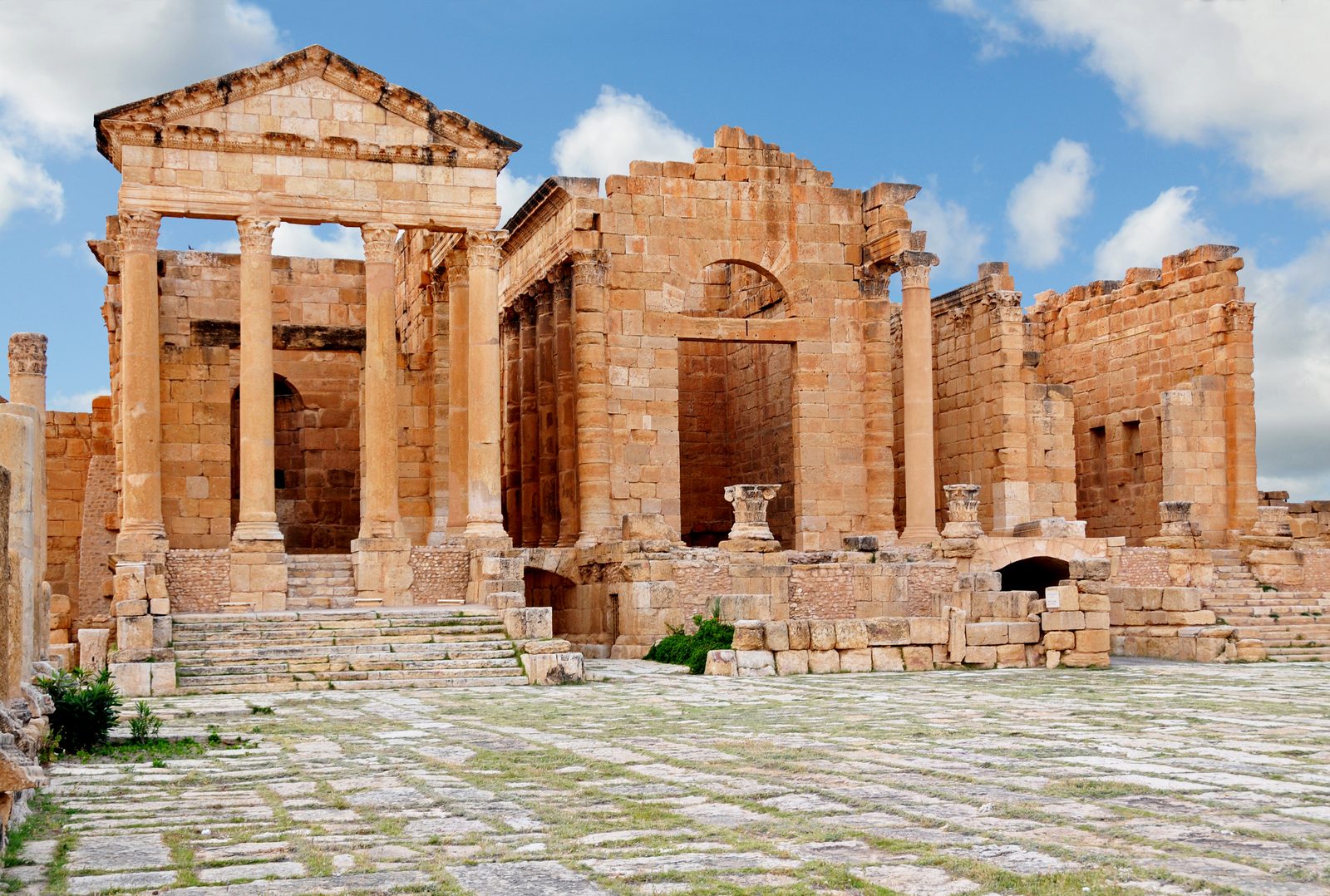
Three temples side by side, standing, facing the forum. That is the first thing you see when you enter Sbeitla, and it is what makes this site unique in the entire Roman world. Everywhere else, the Capitoline triad — Jupiter, Juno, Minerva — shared a single temple. Here at Sufetula, each deity received its own, separate, linked to the others only by narrow passages. Nobody knows exactly why. What we know is that these three temples are still standing, their Corinthian columns intact, in the middle of a central Tunisian plain that nothing prepares you for.
Key facts
| Where | Kasserine governorate, central Tunisia |
| Ancient name | Sufetula |
| Founded | 1st century AD |
| Distinctive feature | Three separate capitoline temples, unique in the Roman world |
| Time needed | 2 to 3 hours |
| From Sousse | About 3 hours by road |
| From Tunis | About 3 h 30 by road (250 km) |
The three capitoline temples
The forum at Sufetula is closed on the north side by three Corinthian temples in a row. The central one, the largest, was dedicated to Jupiter. To its left, Juno. To its right, Minerva. Each is a complete building with its own podium, its own columns and its own pediment. Vaulted passages allowed movement between them without descending to forum level.
In every other part of the Roman Empire, the Capitoline triad shared a single temple divided into three cellae. At Sbeitla, each god received an independent building. Archaeologists have put forward several theories: local Punic influence, the generosity of three different benefactors, or a straightforward architectural choice. None is certain.
What is certain is the state of preservation. Jupiter's columns still stand at full height, the Corinthian capitals are finely carved, and the plan of each temple is clearly legible. In the late afternoon, when the low light gilds the stone, the forum at Sbeitla is one of the most striking sights in Tunisian archaeology.
Diocletian's arch and the forum
You enter the site through a triumphal arch dedicated to the emperors Diocletian, Maximian, Constantius and Galerius, which marks the southern edge of the forum. The arch is well preserved, with its pilasters and attic storey. Beyond it the forum opens lengthwise, paved, lined with statue bases and porticoes whose columns still stand in places. At the far end, the three temples close the view.
The Byzantine churches
After the Roman period, Sufetula became an important Christian centre. Several churches and chapels were built between the 4th and 7th centuries. The standout pieces are the basilicas with their baptisteries: baptismal fonts in the shape of a cross or trefoil, lined with polychrome mosaics that are still visible. The motifs — fish, vines, crosses, peacocks — show a level of craft that rivals anything in Ravenna.
The Basilica of Vitalis, the best known, preserves a Greek-cross baptistery whose floor mosaics are intact. It is one of the finest surviving witnesses to North African Christianity.
Olive oil on an industrial scale
Sufetula was also a centre for olive oil production. Large-scale pressing installations have been found on the site: lever-and-counterweight presses, settling tanks, storerooms. Roman Tunisia was one of the empire's main olive oil exporters, and Sufetula was a key link in the chain. Olive trees still cover the surrounding plain.
The Battle of Sufetula, 647 AD
In 647 an Arab army from Egypt, commanded by Abdallah ibn Saad, met the Byzantine army of Exarch Gregory on the plain of Sufetula. Gregory was killed, his army defeated. It was the first major victory of the Arab conquest in North Africa. The city was taken and sacked. It never truly recovered, and it is paradoxically that destruction which preserved the Roman ruins: nobody came to build on top of them.
Practical tips
- Paid entry with photography permit. Around 8 dinars.
- No shade on the site. Hat, sunscreen and water are essential in summer.
- Comfortable shoes. The ground is uneven and the ruins are spread out.
- Best time: spring or autumn. Summer is scorching on the plain.
Frequently asked questions
They are different experiences. Dougga is perched on a hill with an extraordinary view and an intact theatre. Sbeitla sits on a plain, but its three capitoline temples have no equivalent anywhere, and its Byzantine baptisteries are among the finest in the country.
Allow 2 to 3 hours to see the forum, the temples, the churches and the olive presses properly. With a guide the visit is much richer.
A small museum at the site entrance displays mosaics, stelae and objects found during excavations. It is worth a stop before or after visiting the ruins.
Visit Sbeitla with us
Three temples unique in the world, Byzantine mosaics and 2,000 years of history. Sbeitla can be included in a Grand Heritage Tour itinerary.
See the Grand Heritage Tour → Map of places to visit