 Wonders of
 Carthage, from Punic empire to Roman ruins
Carthage is one of the heaviest names in Mediterranean history. Founded around 814 BC by Phoenician settlers from Tyre, it became Rome's great rival, the master of western maritime trade, and eventually the city that Rome razed so thoroughly people doubted anything was left. Yet Carthage still exists: today it is an upmarket residential suburb north of Tunis, and beneath its villas and gardens lie centuries of Punic and Roman remains, listed as a UNESCO World Heritage site.
Key facts
| Where | Northern suburbs of Tunis, Tunis governorate |
| Founded | Around 814 BC by Phoenicians from Tyre |
| Destroyed | 146 BC (Punic Wars), refounded by Augustus |
| Status | UNESCO World Heritage (1979) |
| Visit time | 3 hours to half a day |
| From Sousse | About 2 h 30 min by road |
Punic Carthage: Dido, Hannibal and the Punic Wars
Legend has it that Queen Dido (Elyssa), fleeing Tyre after her husband's murder, struck a deal with the local Berber king for as much land as an ox hide could cover. She cut the hide into strips so thin they encircled the entire Byrsa Hill. The founding myth, told by Virgil in the Aeneid, captures something true: Carthage was born from cunning and trade, not military conquest.
For six centuries Carthage dominated the western Mediterranean. Its ships controlled trade routes, its trading posts stretched from Spain to Sicily. Then Rome grew, and the two powers clashed in three Punic Wars. The second saw Hannibal cross the Alps with elephants and humiliate Rome at Cannae. The third, in 146 BC, saw Rome level Carthage stone by stone.
Roman Carthage: reborn under Augustus
A century after the destruction, the emperor Augustus refounded Carthage in 29 BC as a Roman colony. The city became the capital of Africa Proconsularis and the second city of the Western Empire, behind Rome itself. The Romans built over the Punic ruins: vast baths, villas, theatres, a circus, aqueducts. It is mainly this Roman Carthage that you see today.
The Antonine Baths
The Antonine Baths are Carthage's most spectacular monument. Built in the 2nd century under Emperor Antoninus Pius, they were the largest baths in Africa and among the biggest in the Roman Empire. Only the foundations and a few columns survive, but their scale lets you imagine the building: the cold room (frigidarium) was about 22 metres wide.
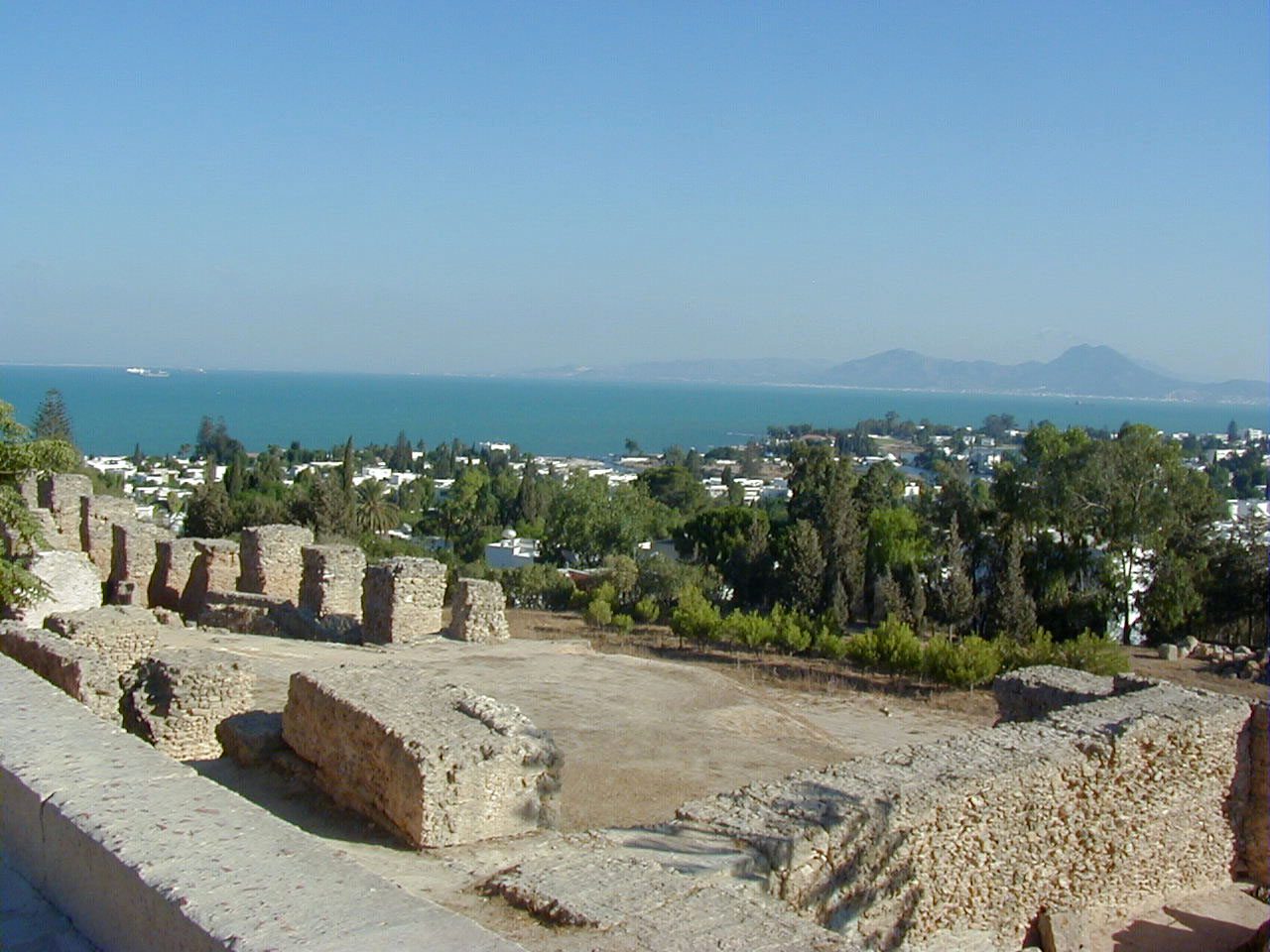
The site is beautifully positioned by the sea, facing the Gulf of Tunis. You walk among the massive foundations, underground water channels and granite columns lying where they fell. The sea views are superb.
Byrsa Hill and the national museum
Byrsa Hill, the historic heart of Carthage, offers a panoramic view over the Gulf of Tunis, the Punic ports and the modern city. At the top stands the Cathedral of Saint Louis (19th century) and the National Museum of Carthage, housing outstanding collections: Punic stelae, sarcophagi, Roman mosaics, everyday objects.
On the hillside, excavations have uncovered a 3rd-century BC Punic residential quarter — one of the rare glimpses of Carthaginian town planning before the Roman destruction.
The Tophet
The Tophet is Carthage's oldest and most enigmatic sanctuary. An open-air enclosure where thousands of stelae and urns were found, containing cremated remains of children and small animals. Archaeologists still debate: human sacrifices, or a cemetery for infants who died young? The place is striking, silent, scattered with a few trees between the stelae.
The Punic ports
Two circular lagoons, visible from Byrsa Hill, mark the site of Carthage's ancient harbours: the commercial port (rectangular) and the military port (circular), which could house 220 warships. Today they are peaceful basins lined with houses, but their shape has remained intact since antiquity.
Practical tips
- Combined ticket: a single ticket covers all the archaeological sites of Carthage.
- Best time: all year round, but spring and autumn are the most pleasant.
- Access: TGM light rail from Tunis — Carthage-Hannibal or Carthage-Byrsa stations.
- Bring: hat and water in summer. Walking shoes for the sites.
How to get there
Carthage is 15 minutes from central Tunis by TGM commuter train. From Sousse, allow about 2 h 30 min on the motorway. On an organised excursion, Carthage is often combined with Sidi Bou Saïd and sometimes the Bardo Museum.
Frequently asked questions
At least 2 h 30 min for the main sites (Byrsa, Baths, Tophet). Half a day if you take your time and add the ports and the theatre.
They are very different. El Jem is a single, spectacular monument. Carthage is a scattered collection of sites, subtler, where you have to imagine the lost grandeur. Both are worth visiting.
Yes, but they are scarce. The Punic quarter on Byrsa Hill, the Tophet and the ports are the most visible remains. Most of Punic Carthage was destroyed and then buried under the Roman city.
Absolutely — it is the classic pairing. Sidi Bou Saïd is five minutes from Carthage by car. We offer this combination on our Sidi Bou Saïd excursion.
Visit Carthage with us
Antonine Baths, Byrsa Hill and Punic ports, combined with Sidi Bou Saïd in the same day. Departing from Sousse or Hammamet.
See the Sidi Bou Saïd excursion → Map of places to visit