 Wonders of
 Bulla Regia, the underground Roman villas
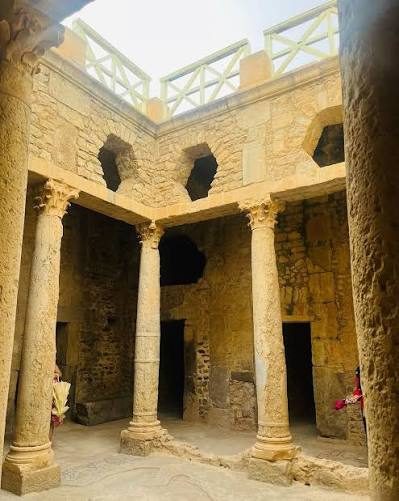
Bulla Regia is a site that exists nowhere else in the Roman world. Here, the wealthy landowners of the 2nd and 3rd centuries did not just build houses: they dug a second storey underground, with rooms, reception halls, peristyles and mosaics as fine as those above ground. The reason is simple: heat. In summer, in this plain of northwest Tunisia, temperatures regularly exceed 45 °C. Six metres below ground, it stays cool all year round. It is Roman air conditioning, and it is unique.
Key facts
| Where | Near Jendouba, northwest Tunisia |
| Ancient name | Bulla Regia (Numidian royal city, later Roman) |
| Period | 2nd to 4th century AD (underground villas) |
| Unique feature | Villas with underground floors, the only ones in the world |
| Visit time | 1 h 30 min to 2 hours |
| From Sousse | About 3 hours by road |
Why underground?
The answer is one word: heat. The Medjerda plain, where Bulla Regia stands, is one of the hottest parts of Tunisia in summer. The Romans knew how to cool houses — inner courtyards, fountains, thick walls — but here it was not enough. So the richest owners had a radical idea: build a second storey below the ground floor.
These underground floors are not cellars. They are real living spaces, with high ceilings, columns, floor mosaics and light wells that let daylight in. In summer, the temperature stays around 20 °C when it is 45 °C outside. People lived, entertained and slept down there during the hottest months. It is an architectural solution unique in the Roman Empire — found nowhere else.
The villas and their mosaics
The House of the Hunt
The most famous. The underground floor is nearly intact, with a columned peristyle surrounding an inner courtyard open to the sky. The mosaics show hunting scenes — deer, greyhounds, horsemen — of remarkable liveliness. You descend a staircase and find yourself in a Roman salon six metres below ground, with light falling from above. The effect is striking.
The House of Amphitrite
This villa houses the site's most celebrated mosaic: Amphitrite (or Venus), standing in a shell, surrounded by marine creatures. The mosaic is still in its original position, on the floor of the underground level. The fineness of the work — tesserae under one centimetre across — and the preservation of the colours are exceptional.
The other villas
Several more houses have been excavated, each with its own underground floor and mosaics: the House of the Treasure, the House of the Fisherman. Some mosaics have been moved to the Bardo Museum in Tunis, but many remain in situ, which is rare and valuable.
The upper city: forum, theatre and temples
Bulla Regia is more than underground villas. The surface city included a forum, a 3,000-seat theatre, baths, a market and several temples. The theatre is partially restored and its structure is clear. The forum, less well preserved, still lets you grasp the layout of a provincial Roman town.
The city was originally a Numidian settlement, allied to Rome, before becoming a Roman colony under Hadrian. Its name, "Bulla Regia" (Bulla the Royal), recalls its past as a Numidian royal seat.
Bulla Regia and Dougga: two complementary sites
Dougga, the other great Roman site in the northwest, is about an hour away by road. The two complement each other perfectly: Dougga impresses with its Capitol, its theatre and its landscape setting. Bulla Regia surprises with its underground villas and in-situ mosaics. Visiting both in the same day gives a complete picture of Roman life in North Africa.
Practical tips
- Rarely crowded: you will often have the site to yourself, which is a rare luxury.
- Closed shoes recommended for going down into the basements.
- Best time: all year round. In summer the underground levels are pleasantly cool.
- Bring: water and a hat for the surface parts. A torch for the basements.
How to get there
Bulla Regia is near Jendouba in northwest Tunisia. From Sousse, allow about 3 hours by road. From Tunis, about 2 hours. The site is accessible by car. There is no regular tourist transport, but we include Bulla Regia in some Grand Heritage Tour excursions.
Frequently asked questions
Yes, several mosaics are still in situ, notably in the House of Amphitrite and the House of the Hunt. Some have been moved to the Bardo Museum in Tunis, but what remains on site is exceptional.
Allow 1 h 30 min to 2 hours for the main villas and the theatre. Longer if you explore every underground level methodically.
Yes, it is the ideal combination. Dougga is about an hour away. The two sites complement each other perfectly and can be visited in the same day.
Very few. A guardian, sometimes a small café at the entrance. Bring water and food.
Visit Bulla Regia with us
The world's only underground Roman villas, often combined with Dougga on our Grand Heritage Tour from Sousse or Hammamet.
See the Grand Heritage Tour → Map of places to visit